
Ever wondered how doctors measure a heavy heart or a racing mind? We need good ways to track our feelings. The phq 9 gad 7 helps doctors understand our mental state well.
These questionnaires came from the Primary Care Evaluation of Mental Disorders system. Drs. Robert L. Spitzer and Janet B.W. Williams made them. They help doctors give us a clear diagnosis.
Kurt Kroenke and his team made these tools short but very useful. One checks how bad depression is. The other looks at anxiety in everyday life. They help track how we’re doing and make sure we get the right care.
Key Takeaways
- These tools assess the severity of depression and anxiety symptoms efficiently.
- Renowned medical doctors and researchers developed these validated questionnaires.
- They serve as essential instruments for initial mental health screenings.
- Clinicians use them for the ongoing assessment of patient progress over time.
- The tools belong to the broader PRIME-MD diagnostic assessment system.
- They help provide a standardized language for mental health professionals across the United States.
What Are the PHQ-9 and GAD-7 Assessments?
It’s important to know about the PHQ-9 and GAD-7 assessments. They help doctors find and treat mental health problems. These tests are used to check for depression and anxiety.
The PHQ-9 and GAD-7 are simple to use. This makes them great for doctors. They help doctors see how bad symptoms are and what treatment to use.
Overview of PHQ-9
The PHQ-9 is a 9-question test for depression. It asks how often you feel sad over the last two weeks. The answers show how bad the depression is.
The PHQ-9 scale helps doctors see how well treatment is working. It helps them change treatment plans if needed.
Overview of GAD-7
The GAD-7 is a 7-question test for anxiety. It’s similar to the PHQ-9, asking about feelings over the last two weeks. The scores show how bad the anxiety is.
The GAD-7 helps find and track anxiety. It helps doctors give the right treatment for each patient.
Importance in Mental Health Care
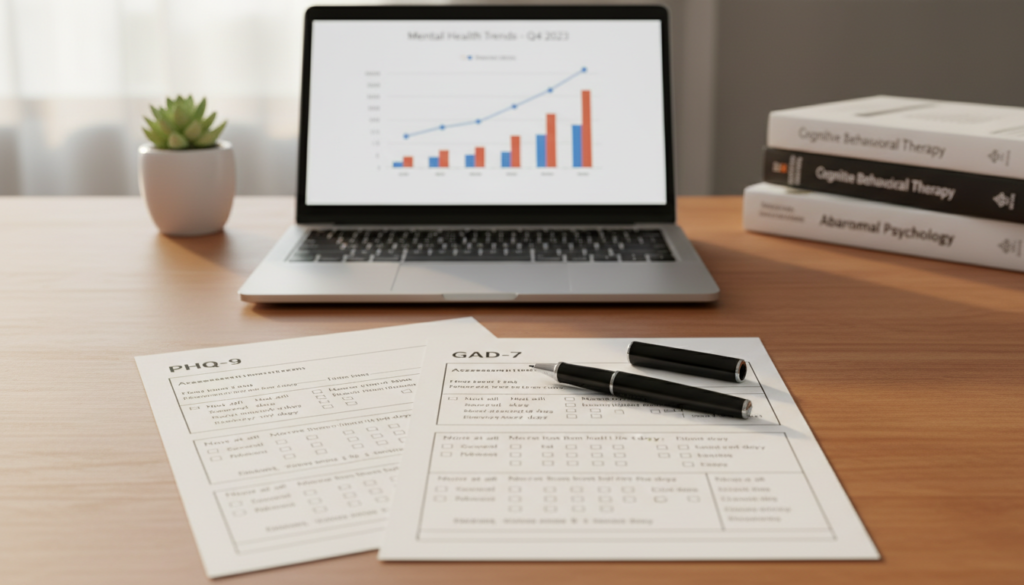
The PHQ-9 and GAD-7 are key in mental health care. They give a standard way to check and track mental health. This helps doctors find who needs more help.
Using the PHQ-9 and GAD-7 questionnaires makes care better. It means treatments are based on real data. This leads to better care and results for patients.
How We Use PHQ-9 and GAD-7 in Clinical Practice
We use PHQ-9 and GAD-7 to check for depression and anxiety in patients. This helps us start treatment early. These tools are key to understanding how serious a patient’s condition is.
Screening for Depression
The PHQ-9 helps us find out if someone is depressed. It shows how bad the depression is. For example, a score of 5 to 9 means mild depression. A score of 20 or more means severe depression.
Key aspects of PHQ-9 scoring include:
- Scores 0-4: Minimal depression
- Scores 5-9: Mild depression
- Scores 10-14: Moderate depression
- Scores 15-19: Moderately severe depression
- Scores 20 or higher: Severe depression
Screening for Anxiety
The GAD-7 helps us find out if someone is anxious. It shows how bad the anxiety is. A score of 0 to 4 means little anxiety. A score of 15 or more means severe anxiety.
GAD-7 scoring is categorized as follows:
- Scores 0-4: Minimal anxiety
- Scores 5-9: Mild anxiety
- Scores 10-14: Moderate anxiety
- Scores 15 or higher: Severe anxiety
Integrating Results into Treatment Plans
The results from PHQ-9 and GAD-7 help us make treatment plans. We check these scores often to see if treatment is working. For more info, see the PHQ-9 and GAD-7 Form.
Interpreting PHQ-9 and GAD-7 Scores
The PHQ-9 and GAD-7 tests help us understand a person’s mental health. They are used to check for depression and anxiety. Knowing the scores helps doctors and patients figure out how serious the problem is and what to do next.
Understanding Score Ranges
The PHQ-9 scores range from 0 to 27. Higher scores mean more severe depression. The scores are divided into levels: mild (5-9), moderate (10-14), moderately severe (15-19), and severe (20-27).
The GAD-7 scores range from 0 to 21. It shows anxiety levels from minimal (0-4) to severe (15-21).
Identifying Severity Levels
PHQ-9 scores help us see how severe depression is. A score of 5-9 means mild depression. Symptoms are there but don’t stop daily life much.
From 10-14, it’s moderate depression. Symptoms are more and start to affect daily life. Scores of 15-19 mean symptoms are very bad and affect daily life a lot. Scores of 20 or higher show severe depression, where daily life is very hard.
GAD-7 scores also show how severe anxiety is. A score of 0-4 means little anxiety. A score of 5-9 means some anxiety but it’s not too bad.
From 10-14, it’s moderate anxiety. Symptoms are noticeable and a bit distressing. Scores of 15 or higher mean severe anxiety, where symptoms are very distressing and can be very bad.
Next Steps Based on Scores
After knowing the severity, we decide what to do next. For both PHQ-9 and GAD-7, higher scores mean we need to act faster and more strongly. For mild scores, we might just watch and suggest some lifestyle changes.
For moderate to severe scores, we might need to see a doctor or therapist. We work with patients to make a plan that fits their needs based on their scores.
Understanding PHQ-9 and GAD-7 scores is key to managing mental health. By knowing how severe depression and anxiety are, doctors can give better support and treatment. This helps patients get better.
Benefits and Limitations of PHQ-9 and GAD-7
It’s important to know the good and bad of PHQ-9 and GAD-7 for mental health checks. These tools help find depression and anxiety. But, they have their own ups and downs.
Advantages of Using Standardized Tools
The PHQ-9 and GAD-7 are good for many reasons. They are easy to use and score. This makes them great for different places.
They help everyone talk the same way about patient symptoms. This makes things clearer for doctors.
Limitations and Considerations
But, PHQ-9 and GAD-7 have some downsides. They depend on what the patient says. This can be affected by culture and personal views.
When looking at scores, remember these points. Scores should be part of a bigger check-up, not the only thing.
When to Seek Comprehensive Assessment
The PHQ-9 and GAD-7 are good for starting, but not for final say. If they show serious symptoms, see a mental health expert.
This expert will do a deeper check. They will make sure of the diagnosis and plan the right treatment. Knowing the good and bad of PHQ-9 and GAD-7 helps doctors use them better.
Resources for Further Information
Looking for more on the PHQ-9 and GAD-7? Many resources are here to help. The phq 9 gad 7 questionnaire and scale are key tools in health care.
Guidelines and Protocols
Mental health groups share guidelines for using these tools. They help doctors and patients understand and treat depression and anxiety better.
Additional Reading
There’s a lot to read about depression and anxiety. These books and articles can help patients and doctors learn more.
Professional Help
Need help from a pro? It’s important to find the right person. Mental health experts can offer support and use the phq 9 gad 7 scale for better care.